
होमKabaddiPakistan Pullout Leaves Inaugural Commonwealth Kabaddi Championship Hollow: India's Dominance Unquestioned — and Untested
Pakistan Pullout Leaves Inaugural Commonwealth Kabaddi Championship Hollow: India's Dominance Unquestioned — and Untested
पाकिस्तान ने राष्ट्रमंडल कबड्डी चैंपियनशिप 2026 से अपनी भागीदारी वापस ले ली है, जिससे पुरुष वर्ग का ड्रॉ 14 से 13 देशों का रह गया। आयोजन 23–31 अक्टूबर 2026 तक अहमदाबाद के वीर सावरकर स्पोर्ट्स कॉम्प्लेक्स में प्रस्तावित है और यह इस चैंपियनशिप का पहला संस्करण है। वापसी का आधिकारिक कारण सार्वजनिक नहीं है; उपलब्ध रिपोर्ट में कोई स्रोत या बयान नहीं दिया गया। ईरान और चीनी ताइपे भी इस आयोजन में नहीं उतर रहे, जिससे प्रतिस्पर्धा का स्तर काफी गिर गया है — ईरान अंतरराष्ट्रीय कबड्डी में भारत के बाद दूसरी सबसे मजबूत टीम माना जाता है और राष्ट्रमंडल सदस्य नहीं है। एशियाई खेल 2026 में भारत ने पुरुष और महिला दोनों वर्गों में स्वर्ण जीता, जबकि पाकिस्तान कबड्डी में पदक से चूक गया; यह दावा कि ऐसा पहली बार हुआ, स्वतंत्र रूप से सत्यापित नहीं है। तकनीकी दृष्टि से पाकिस्तान की चुनौती सर्कल स्टाइल से स्टैंडर्ड स्टाइल में रूपांतरण की बताई जाती है, लेकिन उपलब्ध रिपोर्ट में कोई प्रदर्शन-आंकड़ा नहीं है, इसलिए यह अनुमान है। आयोजन को मान्यता देने वाला निकाय भी स्पष्ट नहीं है, इसलिए खिताब की प्रतिष्ठा एशियाई खेलों या विश्व कप के बराबर नहीं मानी जा सकती।
AHMEDABAD — The inaugural Commonwealth Kabaddi Championship has received the news no new tournament wants: Pakistan has withdrawn. A 14-nation men's draw is now a 13-nation draw. The event is scheduled for 23–31 October 2026 at the Veer Savarkar Sports Complex in Ahmedabad, and the available reporting describes it as the "second major kabaddi event" of the calendar year — the first being the 2026 Asian Games.
What is missing is the question that matters most: why did Pakistan pull out? The reporting carries no reason, no official statement, no federation spokesperson. That distinction governs how the story should be read. What has been reported is an event — a team stepping away. What has not been reported is its cause. Without that cause, describing the withdrawal as "political", "administrative" or "performance-driven" is inference, not journalism.
In the kabaddi domain, last-minute national-team withdrawals have historically been administrative far more often than competitive — clearance delays, visa processing, the timing of government funding release. That is a domain-level generalisation, not a claim about this case. It is worth flagging because public discussion tends to convert such withdrawals instantly into geopolitical narrative, when South Asian kabaddi's international participation has a long record of being disrupted by logistics.
A performance link to the withdrawal is also plausible, and it has a real basis. At the 2026 Asian Games, India won gold in both the men's and women's events; Pakistan finished without a kabaddi medal. The reporting further claims this was the first time Pakistan failed to secure even a bronze. That claim should be treated as data pending verification — Pakistan has featured on Asian Games kabaddi podiums at bronze and silver level in earlier cycles, and without a check against Olympic Council of Asia records, "first time ever" cannot be asserted. The most dramatic sentence in the story is also its least verified.
The serious analysis begins where "they were out of form" ends. Kabaddi is played under two codes, and the gap between them is not merely one of rules but of player production. Standard Style is the rectangular-court, seven-a-side, internationally governed format used at the Asian Games and in the Pro Kabaddi League. Circle Style is played on a circular field, commonly with eight players a side and simplified scoring, and dominates rural Punjab on both sides of the India–Pakistan border. Tactically, they are nearly different sports.
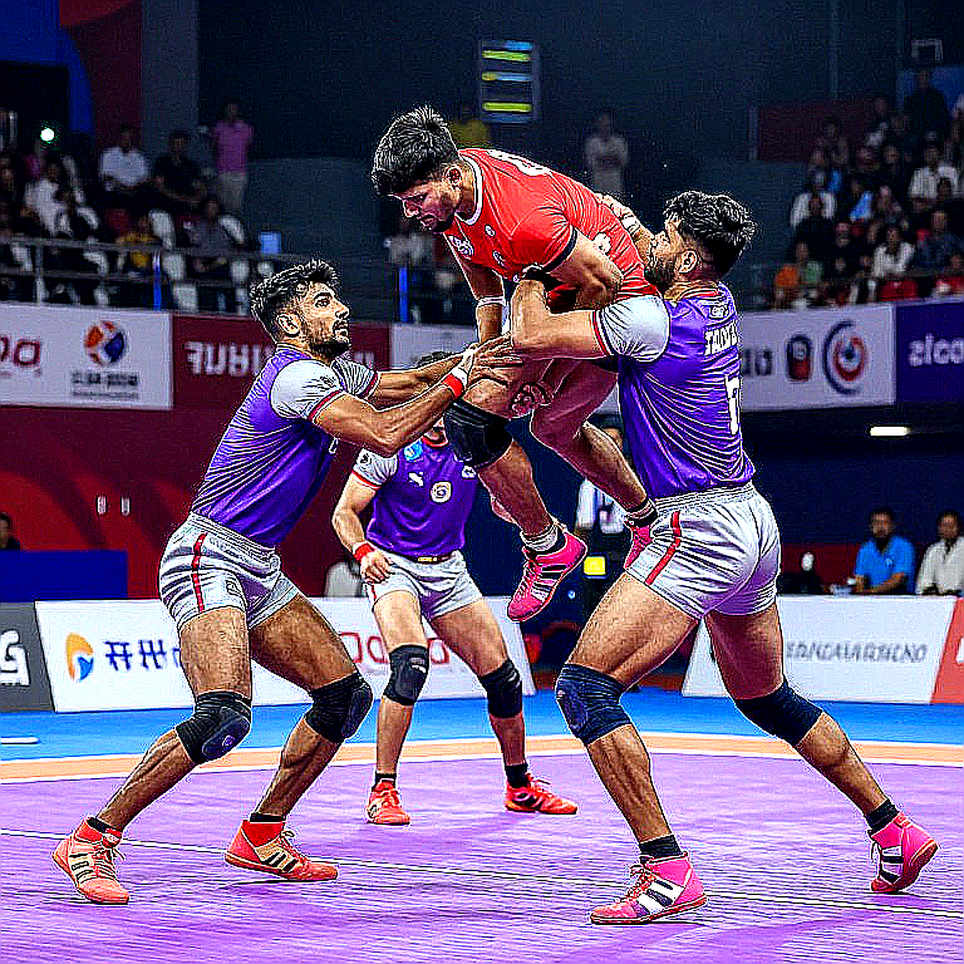
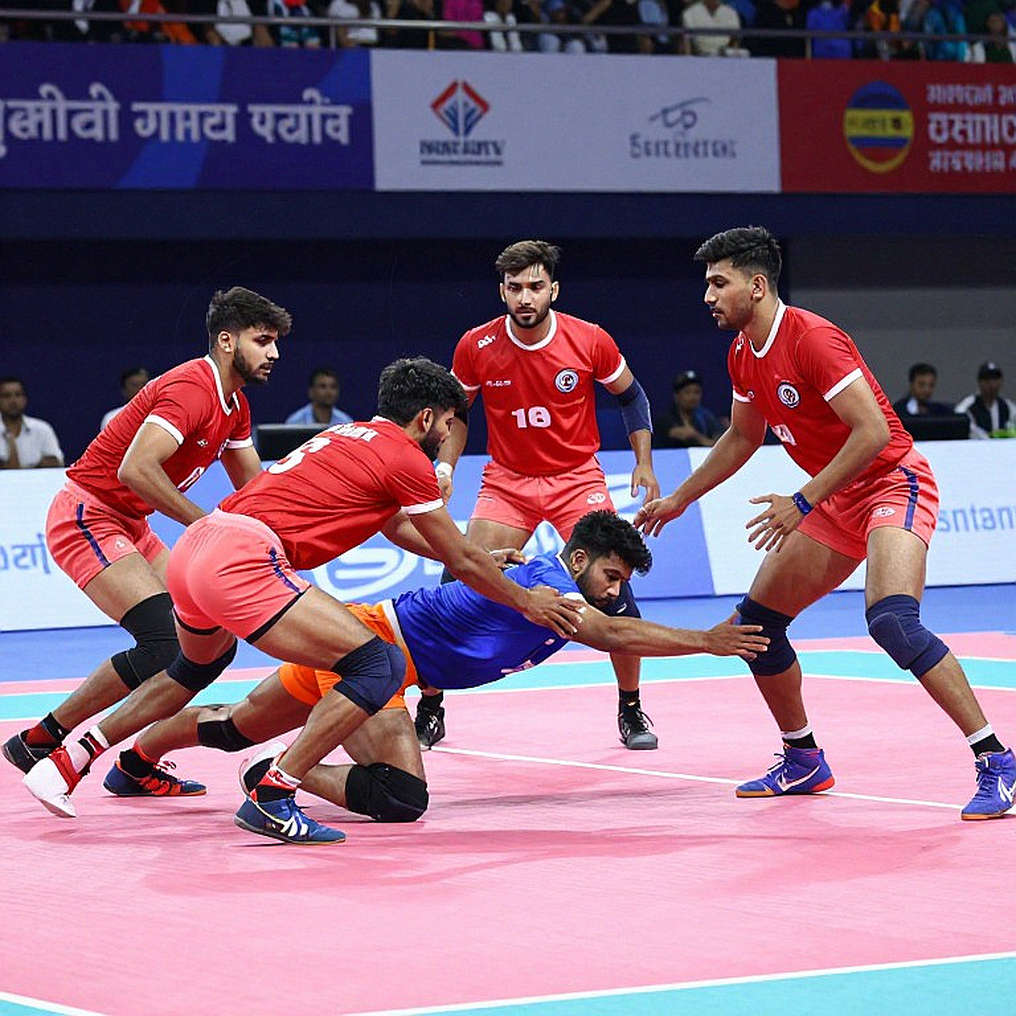
Understanding Standard Style requires the basics. A raider enters the opposing half and must touch at least one defender and return within 30 seconds. Throughout the raid the raider must continuously chant "kabaddi… kabaddi" to prove he is not taking a breath — the one rule that makes kabaddi the only mainstream sport with a built-in breath clock, and the reason most raids die inside 15–20 seconds. Defenders collectively stop the raider; a successful tackle earns the defending side a point and sends the raider out.
Scoring is built on small increments, which is why leads are never safe. A touch is one point; crossing the bonus line is one point when the opposition has six or more defenders on court; a tackle is one point. A Super Tackle — a successful tackle with three or fewer defenders on court — is worth two, and it is the single most momentum-flipping rule in the sport: a depleted three-man defence becomes lethal. Then there is All Out: when every player on one side is ruled out, the opponent gains two bonus points and the entire eliminated team is revived. A 90-second collapse can erase a six-point lead.
On top of that sits the Do-or-Die Raid: after two consecutive empty raids, the third must score or the raider himself is out. The rule exists specifically to punish stalling. Matches are two halves of 20 minutes with a five-minute interval, seven on court, with rotation — a total of roughly 40 to 50 minutes, an ideal broadcast length. But the same rule structure is a hidden handicap for nations raised on Circle Style, where the Do-or-Die compulsion typically does not exist and a raider can retreat without penalty.
The consequence is a recognisable profile: raiders developed in Circle Style are excellent in one-on-one evasion but poor at structured, multi-defender Standard Style raids and weak in disciplined corner-cover defensive systems. Corner and cover are precisely the two positions that decide modern matches. Pakistan's recent Standard Style outings fit this profile — no bonus-line raider, and therefore a side forced into low-percentage touch raids. A team that cannot use the bonus line finds its hands tied against a deep-defending opponent.
Placed in a wider frame, Pakistan's problem looks less like one bad tournament and more like a portfolio failure. No Pro Kabaddi League stake, no overseas-club pathway, and a domestic circuit dominated by Circle Style leave the national side without a mechanism to produce Standard Style specialists. That is inference, not proven fact: the available reporting contains not a single performance statistic — no raid points, no successful raid percentage, no tackle efficiency, no squad composition. Drawing tactical conclusions from that base would be fabrication.
India's position is structurally different. Its advantage is not one star raider but replaceability at every position: a PKL-trained, data-coached pipeline with bench depth of 20-plus international-standard players. An injury during a tournament means a substitution for India; for Pakistan it means a crisis. The Asian Games double gold is the output of that structure, not an upset.
Quality of competition, however, is the real problem for this event. Iran and Chinese Taipei are not participating, and now Pakistan has withdrawn. Iran is the world No. 2 and the only nation genuinely capable of beating India. The result is a 13-nation field that is numerically large and competitively tiny: for everyone other than India, a semi-final is the realistic ceiling. This is a crisis of level, not of numbers.
There is a structural trap here. Kabaddi's global hierarchy is India, then Iran, then everyone else — and Iran is not a Commonwealth member. A Commonwealth championship is therefore, by design, a tournament that cannot contain the one team capable of beating India. That is a design flaw, not a scheduling accident. It also argues for scepticism about the event's prestige. An inaugural edition, an unclear sanctioning authority and a depleted field together warrant caution; South Asian media has a long habit of over-labelling such events as major international tournaments. Until it is confirmed who sanctions this — the International Kabaddi Federation, a Commonwealth kabaddi body, or a national federation acting unilaterally — the title cannot be ranked alongside the Asian Games or the Kabaddi World Cup.
Of the three absentees, Pakistan's is the most damaging commercially. Iran's absence weakens the sporting standard; Pakistan's removes the one fixture with genuine emotional and broadcast pull — India versus Pakistan. That is the pairing that sells tickets and television time, and a first edition depends on exactly such fixtures to establish an identity.
There is also a calendar collision. The Pro Kabaddi League's traditional broadcast window has run from October to December, and this event sits on 23–31 October, creating a direct player-availability conflict for India. Whether India fields a first-choice or a rested squad remains to be seen; if it is the latter, the tournament's standard drops another level.
Behind all of this lies an older ailment that the reporting itself concedes: international kabaddi competitions are limited. There are only a handful of major events a year, and 2026 effectively offers two — the Asian Games and this championship — with no ranking or qualifying pathway linking them. Every forfeited appearance therefore costs a national programme a disproportionate share of its annual development value. Pakistan's withdrawal is not only this tournament's loss but the sport's.
The story now rests on three verifications. First, confirmation of the sanctioning body, which determines what the title is worth. Second, the official reason for Pakistan's withdrawal — administrative, travel-related, or performance and selection strategy. Third, whether the event becomes a recurring fixture; an inaugural edition missing its second-strongest nation and its biggest rivalry is a poor foundation for any tradition.
The conclusion is simple. Pakistan's withdrawal is bad news for the tournament, not for India — an Indian gold remains the most likely outcome. But India's real risk is not losing; it is going untested. Playing repeatedly against a weakened field before facing opponents like Iran has historically dulled sharpness. And if Pakistan's medal-less Asian Games campaign really does reflect a long-term format-conversion problem, stepping away from Ahmedabad does not solve that crisis — it merely defers its reckoning. The most honest reading of this story is this: a new tournament is beginning without its biggest fixture, and nobody has said why.
संबंधित खिलाड़ी
अनुशंसित
Kabaddi's Transfer Window: Between the Noise, the ₹1.65 Crore Ledger and the Real Price of a Third Raider2026-11-02
Ahmedabad, Day One: Where the Table Ranks Teams That Have Not Even Played2026-10-25
The Mud Ledger: Kabaddi's Real Scoreboard in the Regular Season2026-10-24
Ahmedabad's Day-1 Table Is a Calendar, Not a Ranking — and 'Commonwealth' Is a Filter2026-10-25
Kabaddi: From Village Soil to Global Arenas — The Changing Face of a Sport2026-11-02
Kabaddi: From Mud Courts to the Global Stage — The Sport, Its Economics and Its Future2026-11-01
The Scoresheet Is Right, the Table Is Lying: Day One of the Commonwealth Kabaddi Championship in Ahmedabad2026-10-25
Kabaddi's Second Innings: Between the Sport, the Market and the Field2026-11-02
अनुशंसित
Ahmedabad's Broadcaster-Less 'Commonwealth' Kabaddi: 13 Nations, 9 Days, and an Empty Team List2026-11-02
What the Mat Doesn't Show: The Real Scorebook of Kabaddi's Regular Season2026-10-25
Commonwealth Kabaddi Championship 2026: The 42-Point Gap That Explains India's 3-02026-10-27
India's Young Squad Faces England in Ahmedabad: Surjeet Singh Leads at Commonwealth Kabaddi Championship, Key Players Rested2026-11-03
The Rs 1.65 Crore Question: PKL Auctions Buy Clips, Not Points2026-10-31
Kabaddi's Payroll: Who Gets Paid and Who Merely Runs2026-10-24
Commonwealth Kabaddi Championship 2026, Day 1: The Team Sitting Fourth Has Not Raided Once2026-10-25
Surjeet Singh Named India Captain, Naveen Kumar His Deputy for Commonwealth Kabaddi Championship 20262026-11-03
अनुशंसित
The Rs 1.65 Crore Question: PKL Auctions Buy Clips, Not Points2026-10-31
Kabaddi's Transfer Window: Between the Noise, the ₹1.65 Crore Ledger and the Real Price of a Third Raider2026-11-02
Kabaddi's Two Ledgers: The Auction Count, and the Game That Never Gets a Bid2026-10-26
Kabaddi: From Village Crossroads to Global Leagues — The Economic, Cultural and Political Journey of a Sport2026-11-02
Kabaddi's Second Innings: Between the Sport, the Market and the Field2026-11-02
Match 4 in Ahmedabad: India's Rotated Squad, England, and a Title Whose Price Must Be Settled First2026-10-24
Kabaddi: From Mud Courts to the Global Stage — The Sport, Its Economics and Its Future2026-11-01
The Kabaddi Map: From the 3.75-Metre Baulk Line to Jakarta's 18-272026-10-25